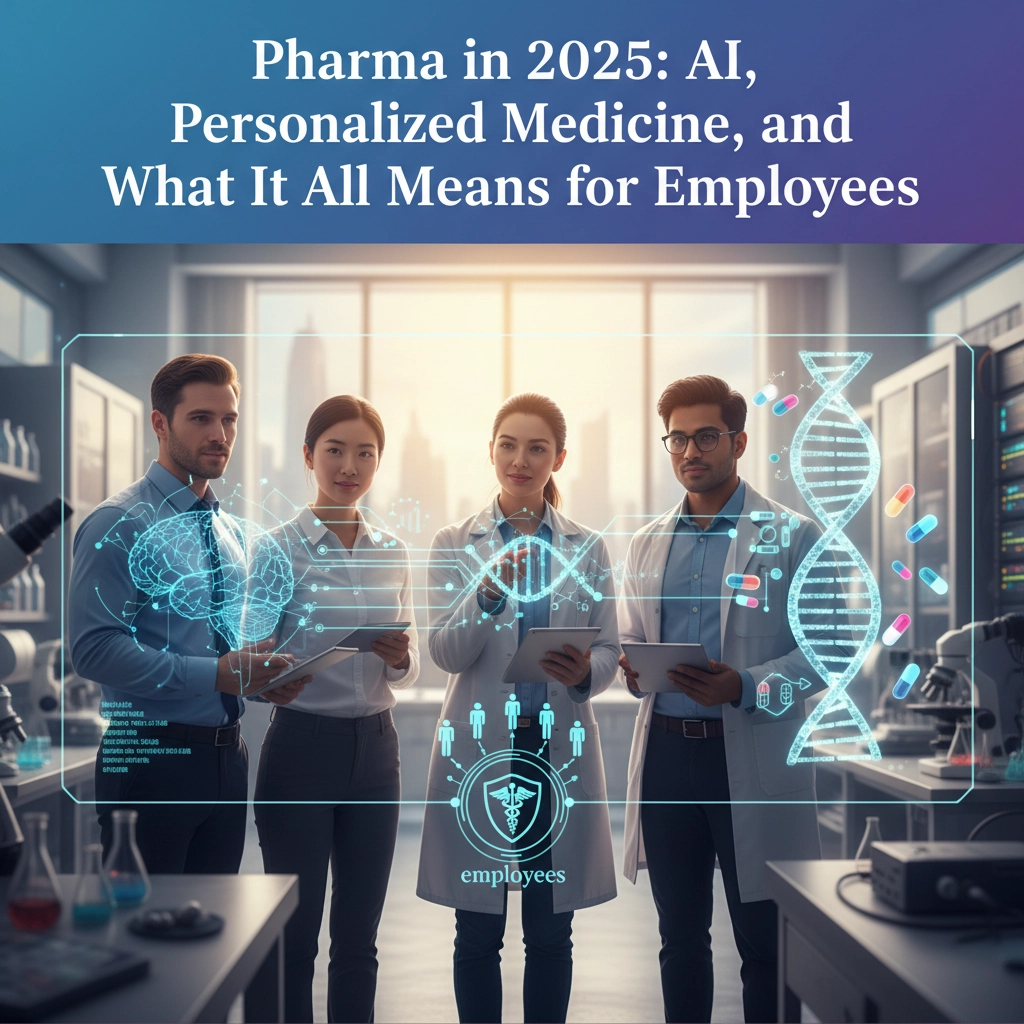
The pharmaceutical industry is having its “iPhone moment”, and it’s happening right now. We’re watching AI fundamentally reshape drug discovery while personalized medicine transforms patient care. But here’s what most headlines miss: behind every algorithm and every precision therapy are real people trying to figure out where they fit in this brave new world.
Let me walk you through what’s actually happening on the ground, how it’s changing jobs across the board, and why I think the companies that get this balance right will be the ones still standing when the dust settles.
The AI Revolution Is Here (And It’s Moving Fast)
AI isn’t just some futuristic concept anymore, it’s driving 30% of new drug discoveries in 2025. That’s not a typo. We’ve gone from AI being a nice-to-have to being the backbone of how drugs get discovered, developed, and delivered to patients.
The numbers tell the story. The AI pharmaceutical market jumped from $1.8 billion in 2023 to what’s projected to be $13.1 billion by 2034. But here’s the kicker: AI is already slashing drug discovery costs by up to 40% and cutting development timelines from five years down to 12-18 months. Companies like Exscientia are putting AI-designed cancer drugs into clinical trials within just one year.
This isn’t just about faster research, it’s completely changing how pharmaceutical workforce training needs to work. Traditional process optimization pharmaceutical approaches are getting flipped on their head. Teams that used to spend months analyzing data can now get insights in days. Clinical trials that once took years to design and execute are becoming more targeted and efficient.
The ripple effects touch everything: patient support operations are becoming more predictive, hub services pharma teams can anticipate patient needs before problems arise, and pharmaceutical enablement programs need to prepare people for workflows that didn’t exist two years ago.
Personalized Medicine: Beyond One-Size-Fits-All
While AI grabs headlines, personalized medicine is quietly revolutionizing how we think about patient care. We’re moving from “this drug works for 60% of people” to “this specific treatment plan is designed for your genetic profile, lifestyle, and health history.”
Digital biomarkers are giving us real-time views of patient health in ways traditional biomarkers never could. Think insulin pumps that adjust dosing automatically based on continuous glucose monitoring, or imaging analysis that can spot early-stage cancers that human eyes might miss.
This shift is huge for patient access solutions and patient engagement pharmaceutical strategies. Case management pharma teams are working with richer, more detailed patient data than ever before. Reimbursement pharmaceutical discussions are getting more complex because we’re not just talking about drug costs, we’re talking about comprehensive, personalized treatment plans.
Patient adherence solutions are becoming smarter too. Instead of generic reminders, we’re seeing AI-powered systems that understand individual patient patterns and adjust communication accordingly. It’s the difference between a one-size-fits-all approach and a conversation tailored to each person’s specific needs and challenges.
How This Changes Everything for Employees
Here’s where it gets personal. All this innovation sounds exciting, but if you’re working in pharma right now, you’re probably wondering: “What does this mean for my job?”
The honest answer? Your job description is changing, whether you’re ready or not.
For R&D teams, nearly 40% of pharmaceutical organizations are actively rethinking their entire R&D and product development strategies. If you’re in research, you’re not just competing with other researchers anymore, you’re working alongside AI systems that can generate and test hypotheses faster than any human team.
Clinical research professionals are finding their roles evolving from data collectors to data interpreters. AI can identify patient populations and design trial protocols, but you still need humans who understand the nuances of patient care and can ask the right questions.
Manufacturing and supply chain folks are dealing with a completely different challenge. Personalized medicine means smaller batch sizes, more complex logistics, and supply chains that need to be both flexible and precise. The old playbook of mass production doesn’t work when you’re making treatments tailored to individual patients.
Commercial teams are wrestling with how to market and price treatments that might work for hundreds of patients instead of hundreds of thousands. The blockbuster drug model is evolving, and sales strategies need to evolve with it.
But here’s what I find most interesting: the roles that are growing fastest are the ones that bridge traditional pharma expertise with new technologies. Pharmaceutical workforce training programs are scrambling to keep up, but the people who are succeeding are those who can translate between the technical possibilities and the human realities.
My Take: Why Human Skills Matter More Than Ever
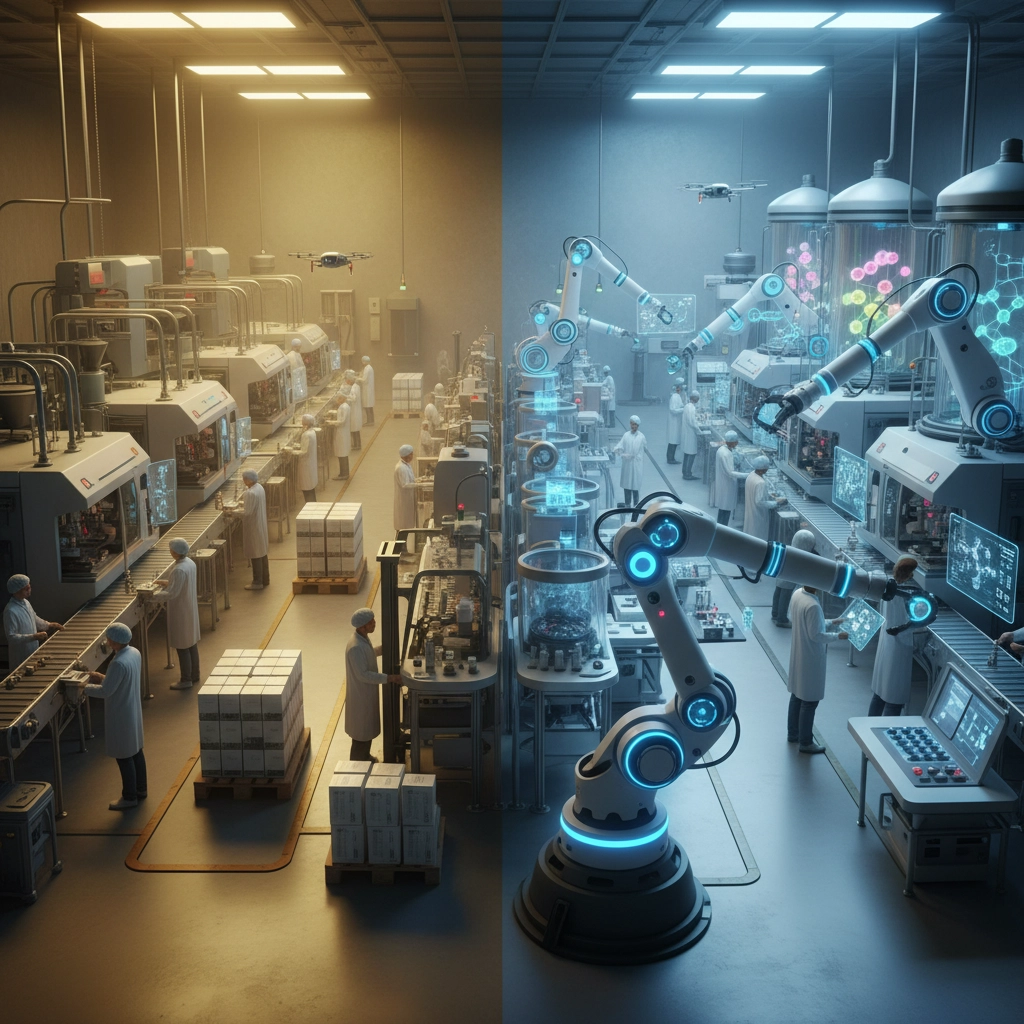
Here’s where I think a lot of companies are getting it wrong. They’re so focused on the technology that they’re forgetting about the humans, both their employees and their patients.
Yes, AI can analyze data faster than any human. Yes, personalized medicine can create more effective treatments. But at the end of the day, healthcare is still fundamentally about human connection and trust.
The most successful pharmaceutical enablement programs I’m seeing aren’t just teaching people how to use new tools: they’re helping teams understand how to work with technology while maintaining the human touch that makes healthcare work.
Think about patient support operations. AI can predict which patients are likely to struggle with adherence, but it takes a human to have the conversation that helps someone stay on their treatment plan. Hub services pharma teams can use data analytics to identify at-risk patients, but building trust and providing support still requires empathy, communication skills, and genuine care.
The companies that will win in this new landscape are the ones that use technology to enhance human capability, not replace it. They’re investing in pharmaceutical workforce training that teaches both technical skills and emotional intelligence. They’re designing process optimization pharmaceutical systems that make their teams more effective, not just more efficient.
The Real Opportunity

What excites me most about this moment is the opportunity it creates for people who are willing to lean into the change. The pharmaceutical industry has always been about improving lives, but we’re entering an era where that mission can be more precise, more personal, and more impactful than ever before.
For employees, this means developing what I call “hybrid skills”: the ability to work with advanced technologies while maintaining the human insights that make healthcare meaningful. It means understanding data science enough to ask good questions, but also understanding patient psychology enough to design solutions that people will actually use.
The teams that figure this out: that balance technological capability with human empathy: are going to be the ones that create the breakthrough therapies and support systems that define the next decade of healthcare.
This transformation isn’t happening to us; it’s happening with us. And the people who embrace both the possibilities and the responsibilities of this moment are going to shape what pharmaceutical care looks like for generations to come.
The question isn’t whether change is coming: it’s whether we’re going to help lead it in a direction that serves both innovation and humanity. That’s the real opportunity in pharma 2025.
 juansense.me
Leave a comment